
A custom kitchen knife starts with a practical question: what do you want it to do? Choose the blade around your everyday prep, check the available range and length, then select the handle you want to use. The result should answer a real job in your kitchen as well as look right on the worktop.
The KIRU knife customiser lets you explore those choices together. This guide explains a useful order for making them, so a striking handle does not distract from the shape you actually need.
Start with the gap in your kitchen
Think about your last few meals. Did you need a general-purpose blade for several ingredients, something smaller for detailed prep, or a dedicated vegetable knife? Write that job down before looking through finishes. If you already own a knife you reach for every evening, a new shape may add more value than another knife for the same task.
Also look at where you prepare food. A longer blade needs working room on the board and a suitable place to store it. A knife should fit the kitchen you have, including the space around the chopping board.
Choose the blade shape first
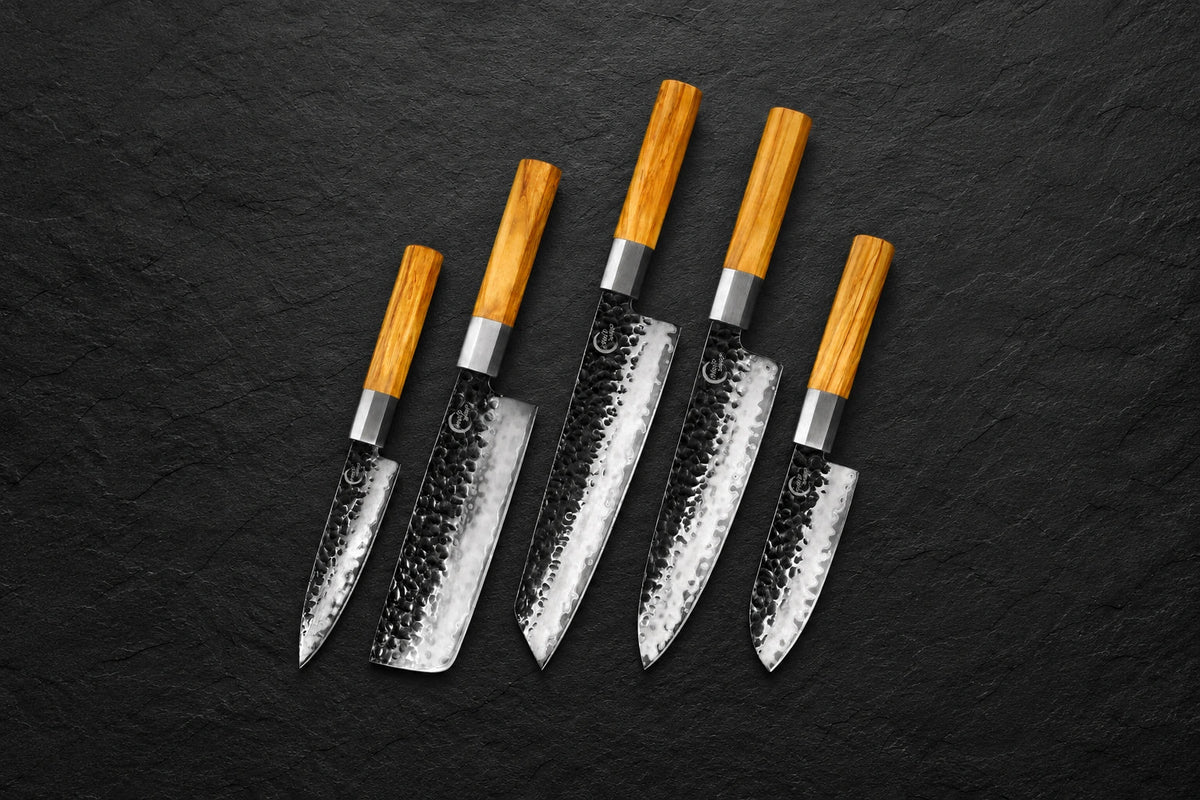
The customiser includes chef’s, kiritsuke, nakiri, bunka, utility, santoku, paring, sakimaru, bread and honesuki options. Treat that as a menu of different roles rather than a list of upgrades.
- Mixed everyday prep: begin by comparing the chef’s knife and santoku options.
- A vegetable-focused addition: look at the nakiri’s broad, rectangular profile alongside the knives you already use.
- Smaller work: compare utility and paring options before choosing a larger blade.
- A specific task: explore the bread, sakimaru or honesuki options with that task in mind, checking the selected blade’s details.
For another practical comparison, read our guide to gyuto and nakiri knives. It can help you decide if you want one blade for mixed prep or a more focused vegetable role.
Read the selected range and length together
In the customiser, changing the blade range can change the options available for your chosen shape. Check the length shown after making each selection. Do not assume that every shape is offered in every range or that two finishes have identical dimensions.
The range selector includes Damascus steel, AUS10 steel and several named finish ranges. A finish name describes a choice in the builder; it is not, by itself, a complete specification or a promise of better cutting performance. Use the selected details rather than judging a blade by its pattern alone.
A simple way to narrow the choice is to compare two configurations with the same intended job. Keep one as your starting point, change a single selection, and check what has changed before moving on.
Choose a handle you will enjoy using
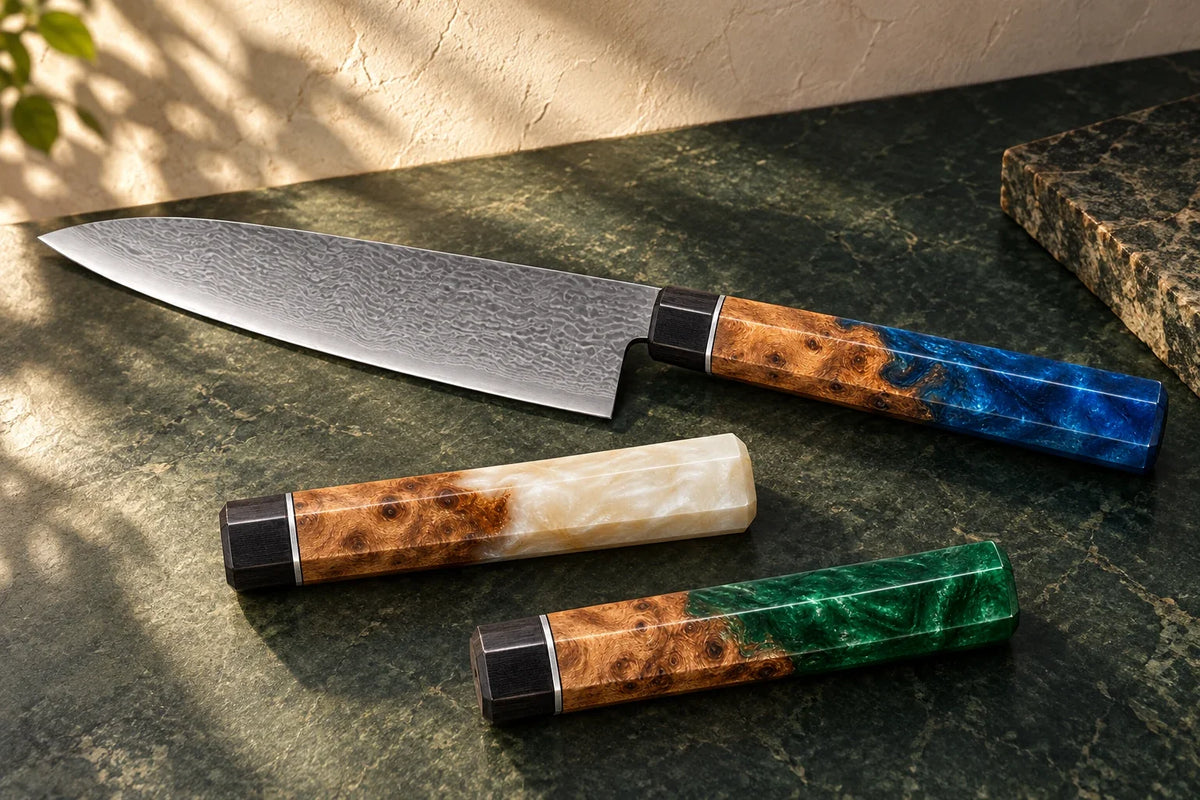
The handle menu can be filtered by wood and bands, lacquer art, wood and resin, or mosaic and collage styles. Ocean blue, pearl white and forest green offer different visual directions within the wood-and-resin choices; ebony wood gives you another starting point.
Compare each handle with the complete knife preview. The proportions matter as much as the colour. A photograph or on-screen illustration can help you compare appearance, but cannot tell you exactly how a handle will feel in your own grip.
The cover image is an illustrative arrangement based on store components. Loose handles in the image represent design choices; they do not mean the finished knife has a user-interchangeable handle system.
Review the complete design before ordering
Check the blade shape, selected range, length, handle and current order summary together. Review any optional personalisation separately. Availability and the displayed total can depend on the chosen configuration, so use the builder’s current summary rather than an example price from a guide.
Once you have a design in mind, plan its storage too. Our kitchen knife storage guide explains what to check before choosing a strip or block.
Custom kitchen knife FAQs
What should I choose first: the blade or handle?
Start with the blade’s job, then compare its shape and available length. Choose the handle once those practical decisions are clear.
Does a more decorative finish mean a better knife?
Appearance alone does not settle the choice. Read the selected details and compare the knife against the prep you want it to handle.
Can I compare a custom knife with an existing series?
Yes. Browse the KIRU knife series alongside the customiser, then compare the listed shape, materials and dimensions of the exact options you are considering.
Explore the knife customiser and build your choice one decision at a time.

Leave a comment
This site is protected by hCaptcha and the hCaptcha Privacy Policy and Terms of Service apply.