
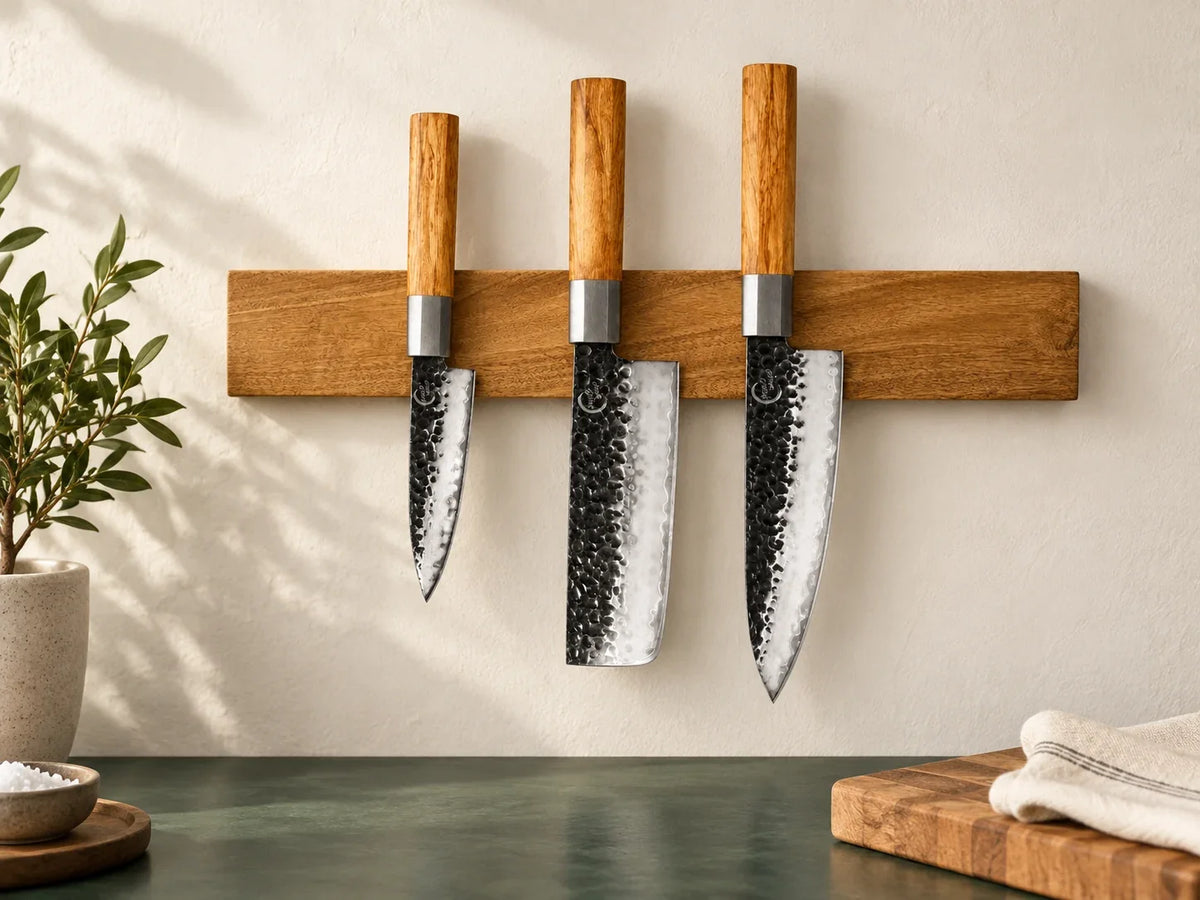
The best place to store kitchen knives depends on your kitchen: the wall space you can use, the worktop you want to keep clear and the blades you reach for most often. Start by giving each knife a separate, dry position where its edge is protected and you can retrieve it without rummaging.
A magnetic strip, a block and an organised drawer solve that problem in different ways. This guide helps you compare them using the space you actually have, with examples from the KIRU knife storage range.
Measure the knives before the storage
Lay out your everyday knives safely on a clear surface and note each blade’s length and height, plus the complete knife’s length. Include the handles in your plan. A strip can look wide enough until several handles need room side by side; a block can suit the blades but still be awkward beneath a low cupboard.
Separate your regular tools from occasional ones. You may want everyday knives near the board and less-used items in another suitable protected location. You do not have to put every kitchen tool into one holder.
Magnetic knife strips: useful when worktop space is limited
A wall strip moves storage off the counter and keeps the knives visible. KIRU’s Acacia Magnetic Knife Strip is a wall-mounted option. The Walnut Magnetic Knife Strip offers a different wood finish, while the Resin Magnetic Knife Strip combines acacia wood and resin in a curved design.
Before choosing one, mark out the whole occupied area, including the handles and blade tips. Check your wall material, the supplied fitting instructions and the reach needed to remove a knife. Do not assume one mounting method suits every wall.
Position the strip away from a busy route, splashes and places where a blade could be knocked. Leave room between knives and use the holder as directed. Magnetic storage still leaves blades exposed, so assess access carefully if children or other household members could reach it.
Magnetic blocks: visible storage without a wall fitting
If you prefer a worktop option, compare the footprint as well as the display space. The Magnetic Knife Block uses a double-sided acacia design. Its two usable faces are helpful only if the position lets you reach both.
The Rotating Magnetic Knife Block has four magnetic sides and a rotating base. Plan the clearance for the knives while it turns, rather than measuring the base alone. Check that the complete setup stays clear of the chopping area and the worktop edge.
A simple test is to place a paper outline of the proposed footprint on your counter. Imagine a knife occupying each intended position. Can you still use the board, open nearby cupboards and retrieve a knife comfortably? That tells you more than a product photo viewed without kitchen context.
Slotted blocks and stands: check the actual fit
The Acacia Wood Knife Block uses a multi-slot layout for different knives and scissors. The Wooden Knife Block Stand offers another solid-wood storage format.
Compare the exact holder with your widest and longest blades before ordering. Do not assume that a broad nakiri, a long slicing blade and a small paring knife will fit equally well into every slot or stand. Check the selected product’s dimensions and ask about fit if a measurement is missing. Avoid forcing a blade into an unsuitable opening.
Drawer storage: organise rather than pile
A drawer can keep the worktop clear, but knives should not lie loose among utensils. Use a purpose-designed insert or appropriate individual blade protection, check the drawer’s internal height and make sure nothing catches when it closes. Choose an arrangement that lets you identify and lift each knife safely.
Do not treat a closed drawer as a complete access-control measure on its own. The right position and any additional household precautions depend on who can reach it.
Keep the storage routine simple
Return knives only after cleaning and drying them. Keep the storage surface clean, follow its care instructions and check wall fittings or bases periodically. If the collection changes, reassess the spacing rather than squeezing in another blade.
For the steps before storage, read our Damascus knife care guide. If you are planning a new blade, the custom kitchen knife guide helps you consider its shape and size before choosing a home for it.
Kitchen knife storage FAQs
Is a magnetic strip better than a block?
Neither suits every kitchen. A strip needs an appropriate wall and placement; a block needs usable worktop space and the right fit for your knives.
Can I store a knife while it is damp?
Dry it thoroughly first. Check the handle and the area near the blade before returning it to storage.
How many knives will a holder take?
Use the listed capacity and dimensions for the exact option, then allow for the size of your own blades and handles. Do not estimate capacity from width alone.
Explore KIRU knife storage with your measurements ready.
Further reading: WÜSTHOF’s overview of kitchen knife storage options.

Leave a comment
This site is protected by hCaptcha and the hCaptcha Privacy Policy and Terms of Service apply.