
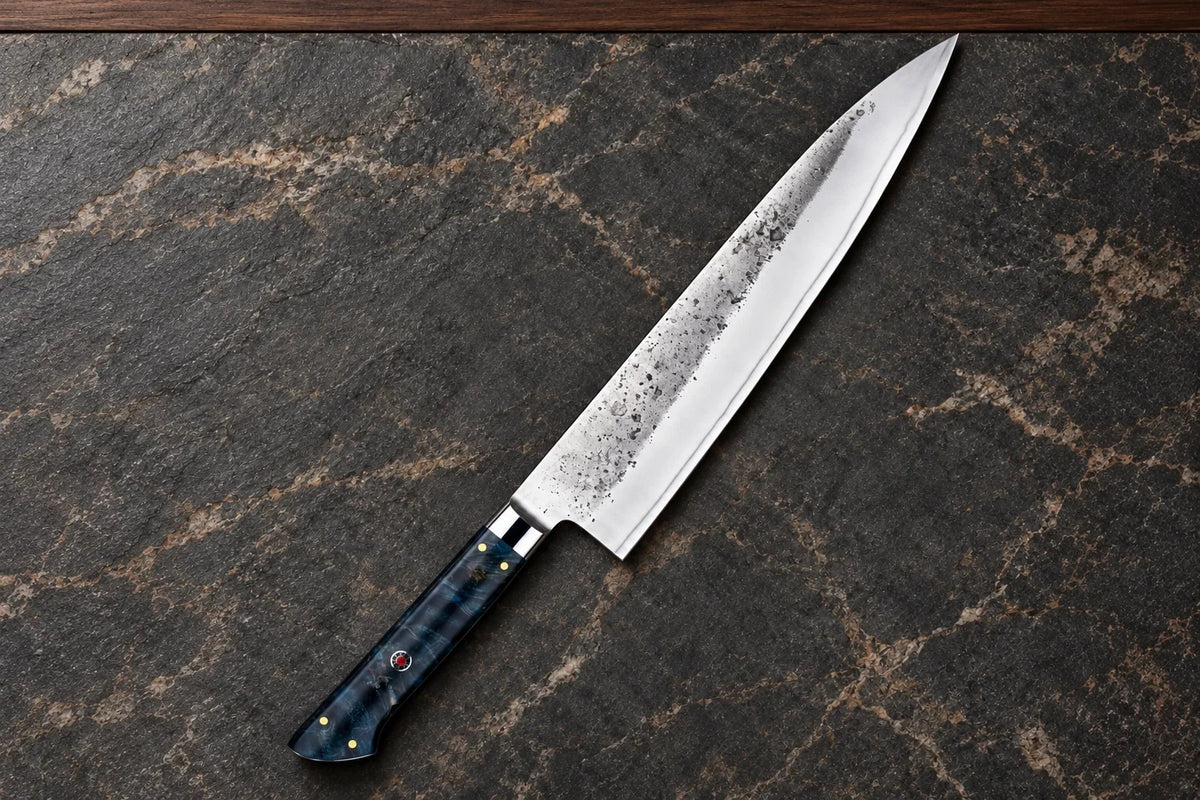
A knife for small kitchen prep should belong to a workable preparation area. Begin with one clear board and the role you need most often, then consider the extra tools around it. KIRU describes the Indigo Series Gyuto Chef Knife for slicing, chopping and dicing vegetables and boneless meat, making it a broader everyday option to assess.
A small kitchen does not have one universal knife length. The useful decision connects the blade’s intended job with the space you have for the ingredient, its prepared pieces and the rest of the meal.
Make room for the ingredient first
Imagine preparing peppers, an onion and a courgette for dinner in the gap between a sink and a hob. Place the board where you normally work, then choose a nearby home for the ingredient bowl. Notice which packets, appliances or utensils regularly creep into the cutting area.
You may prefer to bring one ingredient to the board at a time and move prepared pieces to the bowl beside it. That is a practical layout preference for this example, rather than a requirement to spread the entire meal across the worktop. The aim is to know what the working area needs to hold.
Choose a main role before a collection
If most dinners involve mixed vegetable preparation, start by examining one everyday blade. If the role you lack is mainly small fruit or short lunch tasks, a smaller option may be more relevant. The Timber Series includes separate 3.5 inch Paring and 5 inch Utility options to compare for those smaller jobs.
A cook who already has a useful main knife might add one of these specific smaller roles. A cook starting again might prioritise the broader preparation position first. In either case, the space decision becomes clearer when you know how many actual roles the kitchen needs.
Account for storage as part of the footprint
The knife needs a defined home when the board is put away. The Magnetic Knife Block is listed at 250mm high, 235mm wide and 100mm base depth, with double-sided magnets. Use those exact dimensions to consider where the block could sit alongside the appliances that already occupy your counter.
Include access around the storage location, rather than measuring only a bare rectangle on the worktop. Picture your actual blade and how the nearby objects would be arranged. The listed dimensions give you a starting point for that assessment; they do not establish a capacity for your particular collection.
For a lunch with only a cucumber and tomato to prepare, the smaller role may be enough to examine. For a dinner with several vegetables, the broader main blade becomes the relevant candidate. Keeping those two examples separate helps you avoid adding an extra tool for every ingredient simply because the kitchen is small.
Choose a setup you can return to
A modest preparation corner can still have a clear rhythm: board in place, ingredient bowl nearby, main knife chosen for the task and storage elsewhere in the layout. You may prefer to keep the worktop visually spare or to have a compact block as part of the kitchen’s appearance. Both preferences need a measured location.
Our guide to chef knife length and board space explores the size question in more detail. Browse Knife Storage after deciding the main preparation role. Add each extra tool because it has a place and a useful job in the area you actually use.

Leave a comment
This site is protected by hCaptcha and the hCaptcha Privacy Policy and Terms of Service apply.