
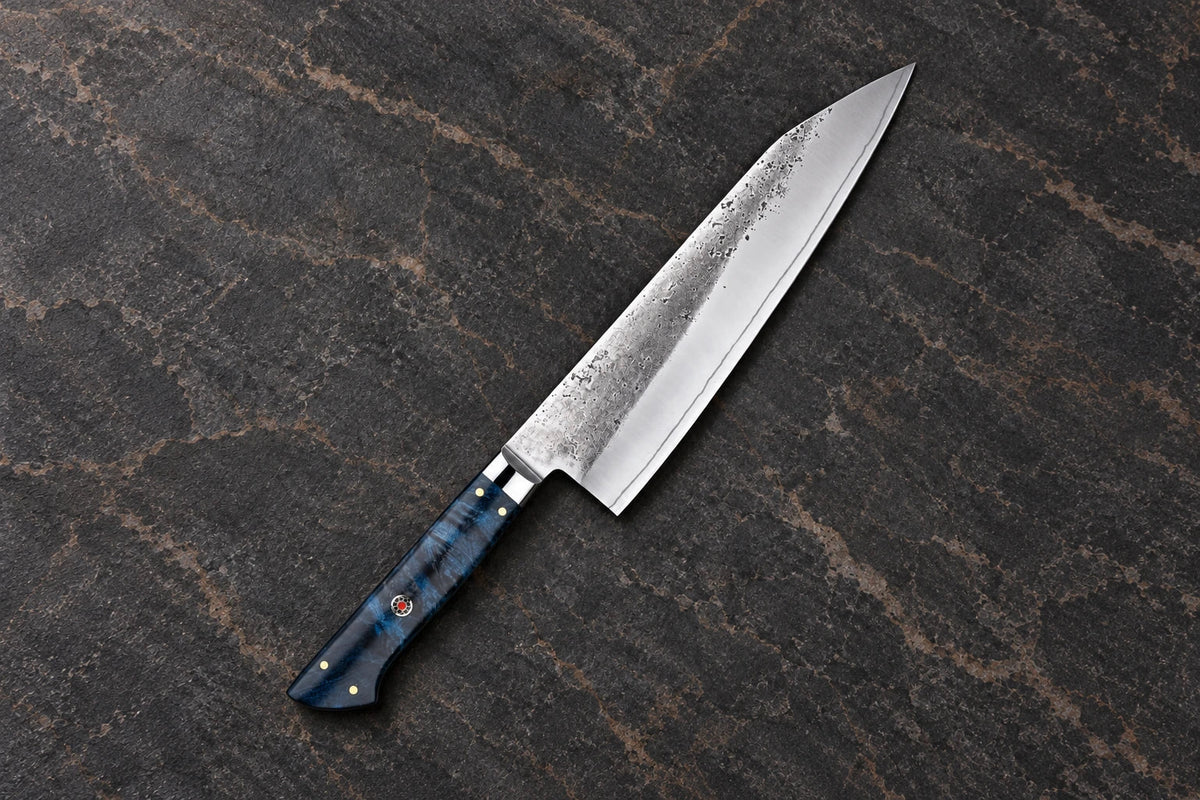
Compare a Kiritsuke and Gyuto through the actual blades and preparation roles you want. KIRU describes the Indigo Series Kiritsuke Knife as a long, angular profile for slicing and precise vegetable work. The Indigo Gyuto is described for everyday slicing, chopping and dicing of vegetables and boneless meat. Those stated roles give you a practical starting point.
Consider whether you want a broader everyday preparation blade or a particular slicing-oriented option. Neither choice needs a story about professional status or the meaning of a Japanese name to make it useful in a home kitchen.
Give the Kiritsuke a concrete preparation job
Imagine a dinner where the prepared vegetables need deliberate strips or slices: courgette, peppers and a few smaller ingredients arranged for a rice dish. If that kind of work is the role you want to focus on, the Kiritsuke’s listed vegetable and slicing use is relevant. Compare its actual outline with the work you picture doing.
KIRU lists the Indigo Kiritsuke blade at 8 inches, approximately 20cm, with a thickness of 2.5mm. Use those figures as information about this model. Lay out your board and ingredient bowl and consider the available working area, especially if the kitchen has a narrow preparation corner.
Give the Gyuto a broader weekly job
The Indigo Series Gyuto Chef Knife becomes the stronger candidate when your list is mixed: chopped vegetables for a sauce one night, sliced ingredients for a tray meal the next and ordinary boneless preparation elsewhere in the week. Its described everyday role helps keep the choice broad without assuming it answers every possible cutting task.
If you are buying your main preparation knife, that variety may matter more than adding a distinct profile. If you already have a useful main knife, the Kiritsuke can be considered as a separate preference for the slicing and vegetable work you want to emphasise.
Read the common details without losing the distinction
KIRU lists stabilised wood handles and 60±2 HRC hardness for both Indigo models. The Kiritsuke listing identifies a three-layer Sanmai construction with a 10Cr15CoMoV core; the Gyuto listing describes a three-layer composite construction with the same named core grade. These are listed model details rather than evidence that the two profiles serve identical purposes.
You do not need to turn that information into a ranking. For this decision, the difference you can act on is the preparation role. Read the material details carefully, but return to the meal and the cuts when choosing which model would earn its place.
For example, a cook who already prepares weekday sauces comfortably might want a distinct profile for vegetable slices in a weekend rice bowl. Another cook replacing several improvised tools may prioritise the broader everyday role first. Both are purposeful choices when tied to a real meal.
Choose a role before adding another blade
A helpful final exercise is to complete one sentence: “I want this knife mainly for…” If the answer lists several ordinary preparation tasks, the Gyuto’s broader description may suit the aim. If the answer centres on deliberate slicing and vegetable work, inspect the Kiritsuke closely as that specific candidate.
A vegetable-only priority is another decision, covered in our Gyuto and Nakiri comparison. Browse the Knife Series after identifying which role matters most. Choose a single Indigo model purposefully, then consider a second only when its job is clearly different in your kitchen.

Leave a comment
This site is protected by hCaptcha and the hCaptcha Privacy Policy and Terms of Service apply.