
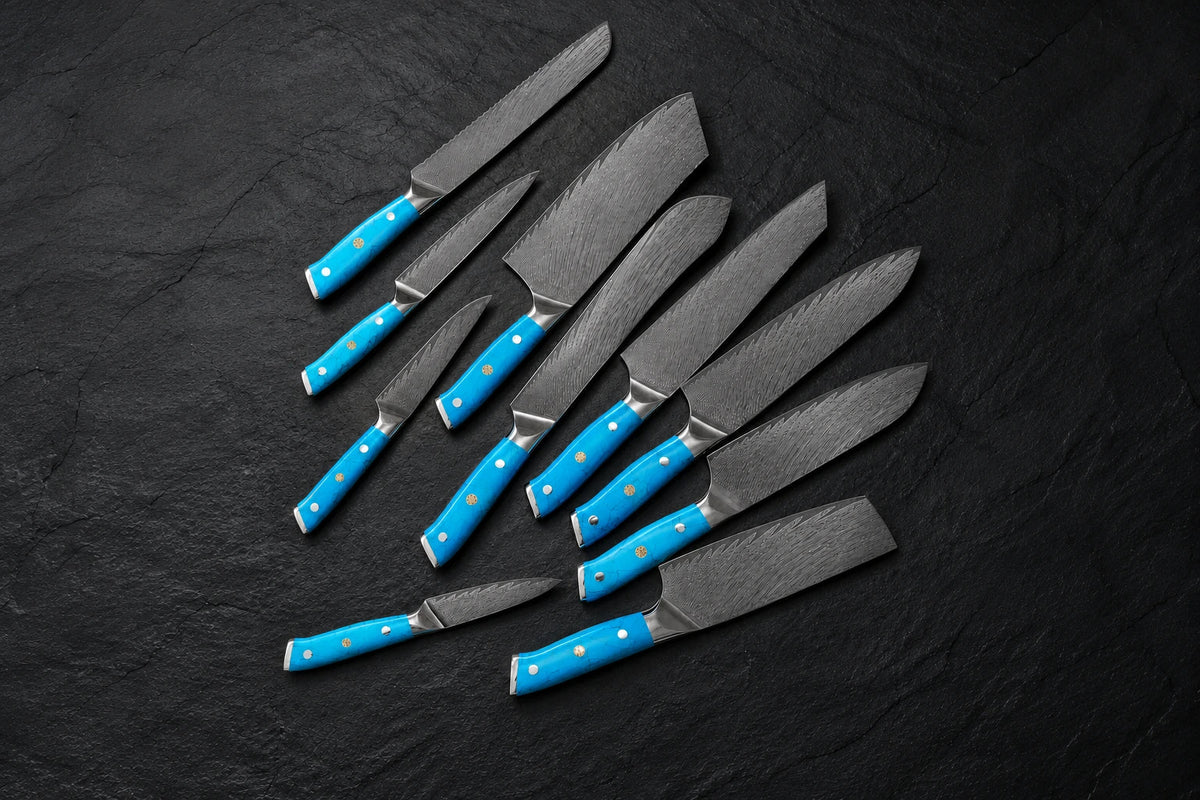
A damascus knife vs laser pattern comparison starts with the written construction, rather than the appearance alone. KIRU lists the Lagoon Damascus Series as 67-layer Damascus steel, with an AUS-10 core and SS316L outer layers. Its Damascus grain pattern is a further listed detail. Read those entries together while keeping the material statement and surface appearance distinct.
A photograph can help you assess whether you like the finish. The product description is where you find the claimed construction. Use each for its own purpose when building a shortlist.
Separate the look from the steel description
The Arctic Blue Series gives a contrasting reference: KIRU lists high-carbon stainless steel and a laser surface pattern. That wording describes a patterned surface; it is a different statement from Lagoon’s named layered construction. Keep the two descriptions intact rather than making them equivalent because both blades have visible patterning.
Arctic Blue also lists a blue resin handle, while Lagoon lists a stabilised turquoise stone handle. Those are separate material preferences to consider. A pattern you like can be part of the decision, alongside the exact blade profile and the way the handle appears in the current product images.
Consider an alternative with a different construction
The Indigo Series Gyuto Chef Knife is listed as three-layer composite steel with a 10Cr15CoMoV core and a hand-polished, sandblasted finish. Its described use is everyday slicing, chopping and dicing of vegetables and boneless meat. This gives you another model-specific combination to compare.
You may be drawn to a stronger visible pattern, a quieter finish or a particular handle material. Name that visual preference clearly, then keep it beside the intended preparation role. A more elaborate-looking blade does not remove the need to choose the actual profile you want.
Compare the same role where possible
Lagoon contains multiple options, including 5 Inch Utility, 7 Inch Nakiri, 8 Inch Chef and 8 Inch Bread. Choose a role before comparing patterned ranges. If your missing job is smaller board preparation, shortlist utility options; if it is a main everyday blade, compare the relevant chef or broader preparation options.
For example, a cook making frequent vegetable dinners may begin with a particular Nakiri option and then consider its listed material and finish. Another cook wanting one broader blade may compare a chef-designated option with the Indigo Gyuto’s stated role. The appearance is a preference within the task decision.
If you are choosing several knives together, consider whether the visual finish is a reason for a coordinated range or whether one particular profile is enough. You can enjoy the patterned appearance of one useful blade without making the same construction a requirement for every kitchen job.
Build a shortlist with four clear details
Record the selected profile, named steel construction, handle material and finish for each candidate. These four entries keep the comparison concrete. If a page states a laser surface pattern, retain that wording. If it names a core and outer layers, retain those as separate construction details.
Then picture the choice in your own kitchen: a vegetable supper, a prepared fruit portion or a mixed dinner. Which candidate has the role you want, and which appearance would you enjoy as part of the setup? That is a more useful final question than choosing by the busiest blade pattern.
Our series variant guide explains the selected-option step. Explore the Knife Series with the practical role decided, then compare each model’s actual construction and surface description before choosing.


Leave a comment
This site is protected by hCaptcha and the hCaptcha Privacy Policy and Terms of Service apply.